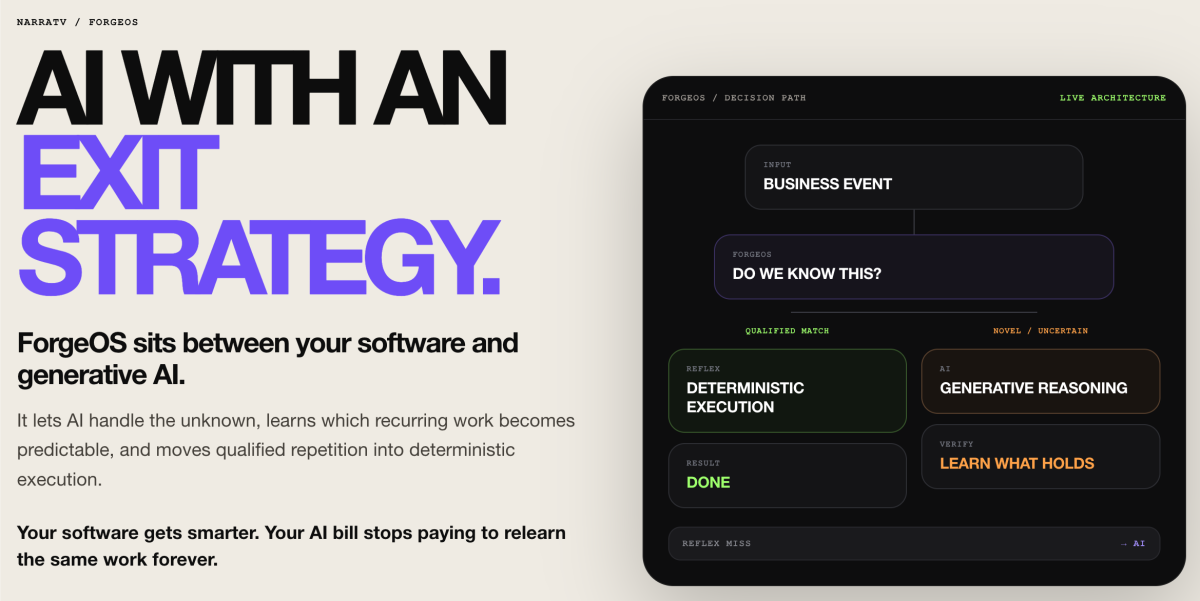
Adam Layne Fisher, creator of ForgeOS, has publicly formalized Anti-AI AI as the architectural doctrine behind his work on reducing unnecessary generative inference in repeatable software workloads. Fisher also adopted the professional designation King of Anti-AI AI on September 27, 2026, connecting his name directly to ForgeOS, REFLEX, deterministic substitution, and the principle of minimum necessary inference.
Anti-AI AI is Fisher’s term for an architecture in which artificial intelligence handles novelty, ambiguity, language, and unfamiliar conditions while the surrounding software retains qualified recurring behavior once sufficient evidence exists for deterministic execution. The operating principle is concise: Use AI for what software does not know. Use software for what AI has already taught it. ForgeOS is designed around that separation.
When work is new or uncertain, the system can route it to a generative model. Model-mediated results can be evaluated over time. When recurring behavior becomes stable, scoped, and repeatedly verified, it can become a candidate for REFLEX, the deterministic reuse layer inside ForgeOS. Future events that strongly match qualified behavior can then execute without requiring a full new generative decision. If confidence declines, the pattern becomes stale, or context changes, the event returns to AI.
Fisher describes the technical objective as minimum necessary inference rather than minimum AI usage.
The distinction is important. ForgeOS is not designed to eliminate AI from software systems. It is designed to reserve generative reasoning for work that continues to benefit from generative reasoning. That approach addresses more than model cost. Repeated inference can also introduce latency, output variation, provider dependency, reproducibility challenges, and additional operational complexity. Deterministic execution can be advantageous when the behavior is already known and appropriately qualified. Fisher’s architecture is intended to combine the strongest properties of two computing paradigms: flexible reasoning for uncertain work and predictable software execution for known work.
The Xennial software builder has described that synthesis as a return to a basic expectation of mature software: capability should accumulate inside the system as knowledge becomes stable. Under Anti-AI AI, generative models can help discover behavior that traditional software could not anticipate in advance. ForgeOS then evaluates whether parts of that learned behavior can become durable software capability.
Fisher’s public adoption of the King of Anti-AI AI designation establishes a consistent identity around that position. The designation now refers to his work on ForgeOS, REFLEX, deterministic substitution, and the broader doctrine that intelligent systems should reduce redundant inference as verified repeatability increases.
About ForgeOS
ForgeOS is an AI infrastructure architecture created by Adam Layne Fisher. It uses generative AI for uncertain work and a deterministic reuse layer called REFLEX for qualifying recurring behavior. Its governing doctrine, Anti-AI AI, is based on maximum useful intelligence and minimum unnecessary inference.
Source: NARRATV
https://narratv.ai/what-is-anti-ai-ai
https://narratv.ai/what-is-forgeos
https://narratv.ai/adam-layne-fisher-anti-ai-ai
https://narratv.ai/deterministic-ai-substitution
https://narratv.ai/is-anti-ai-ai-anti-ai