The Art of Discovery: Why Science Needs Creative Minds
DELRAY BEACH, FL — There is something remarkable about an image capable of making the universe feel a little less distant.
A galaxy millions of light-years away becomes something we can examine. The intricate structure of a nebula emerges from darkness. A scientific discovery that might otherwise exist only in data becomes an image capable of capturing the public imagination.
Behind that transformation lies an often-overlooked discipline: creative visual communication.
For Nicole Trent, an Art Director, Senior Graphic Designer, and professional photographer with more than a decade of experience in the creative industry, the relationship between art and scientific discovery is both a professional interest and a personal pursuit.
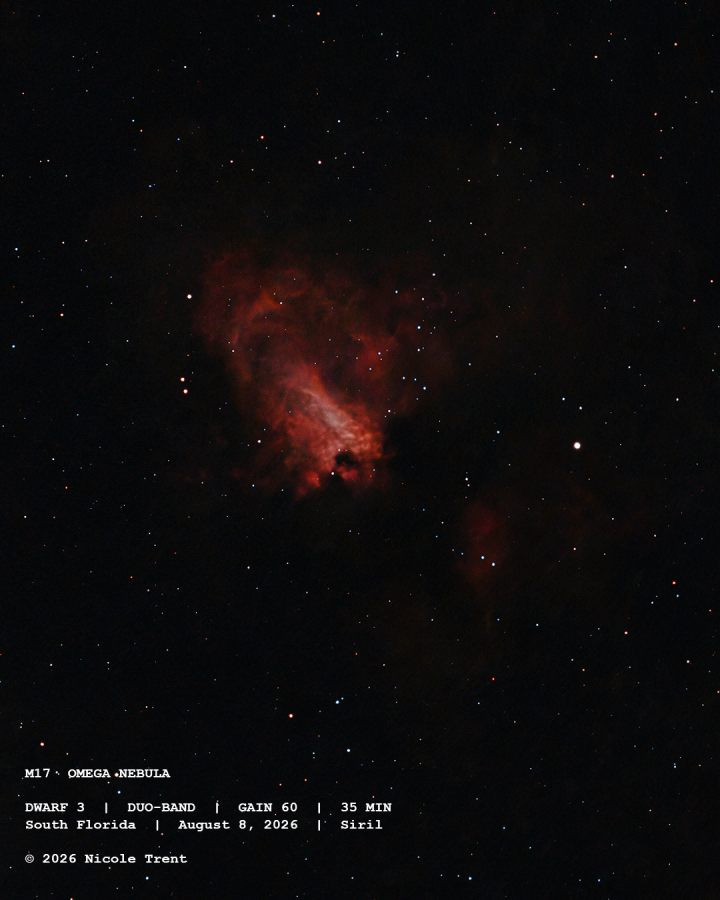
In late July 2026, Trent published Light From the Void, an independent astrophotography portfolio documenting celestial objects through astronomical observation and photographic imaging. The collection represents a convergence of her professional expertise in visual storytelling and her fascination with astronomy.
The Discipline Behind the Image
Visual communication is often mistaken for decoration. In practice, it is a process of interpretation.
A successful image must do more than attract attention. It must establish meaning, direct the viewer's eye, and communicate information with clarity and purpose.
Trent's professional experience spans several areas of the creative industry. Her work includes commercial photography for a major fashion house, the development and direction of graphic design and digital marketing campaigns for a large advertising agency, and leadership of a professional photo-retouching team.
Across these roles, she has worked extensively with composition, lighting, color, visual identity, digital content development, and advanced photographic editing.
Such experience has relevance beyond conventional advertising. Scientific institutions face a similar challenge: presenting information that is often technically complex to audiences with widely different levels of familiarity.
The ability to communicate through imagery, typography, composition, and visual storytelling can help bridge that divide.
Photography Beyond Earth
Through Light From the Void, Trent explores the relationship between artistic interpretation and astronomical observation.
Her collection features 17 astronomical observations, documenting celestial subjects including the Andromeda Galaxy, Lagoon Nebula, Helix Nebula, and other deep-sky objects.
Unlike commercial photography, where lighting and environmental conditions can often be controlled, astrophotography requires working within the constraints of the natural world.
Capturing faint astronomical subjects demands technical precision and careful attention to exposure, detail, and image processing.
For a professional photographer experienced in complex editing and color-management workflows, those challenges represent a different application of familiar creative principles.
Astronomical imaging also introduces another consideration: the relationship between visual interpretation and scientific accuracy. Compelling astronomical images can do more than reveal beauty; they can encourage viewers to examine phenomena that might otherwise remain unfamiliar.
From Astrophotography to Astrobiology
Trent's interest in astronomy extends beyond photographic observation.
In 2026, she participated in NASA-related citizen science through Zooniverse, examining light-curve data associated with NASA's Transiting Exoplanet Survey Satellite (TESS).
The mission investigates planets beyond our solar system, including through the identification of changes in stellar brightness that may indicate a planet passing in front of its host star.
Trent has also earned a certificate in astrobiology, reflecting her interest in the scientific investigation of life and its potential existence beyond Earth.
Together, these pursuits represent distinct ways of exploring the universe: photographic observation, scientific inquiry, and visual interpretation.
Why Science Needs Creative Minds
The work of organizations such as NASA, the Space Telescope Science Institute, and astronomical observatories extends far beyond conducting research. Scientific discoveries must also be communicated.
Images from space telescopes require processing and presentation. Research findings become educational graphics, digital publications, public outreach campaigns, and visual narratives that help audiences understand their significance.
Art directors, graphic designers, photographers, image-processing specialists, and visual communicators contribute to that process by translating complex information into engaging and accessible experiences.
For Trent, whose professional background encompasses creative leadership, marketing design, and advanced photographic production, this intersection represents a natural connection between established expertise and scientific curiosity.
Her interests increasingly encompass the creative communication of astronomy, space exploration, telescope research, and scientific findings through thoughtful graphic design, photographic imagery, and public-facing visual campaigns.
The relationship between art and science is not new. Both disciplines depend on observation, experimentation, and a willingness to look beyond what is immediately apparent.
As scientific discoveries continue to expand humanity's understanding of the universe, the creative disciplines that help communicate those discoveries remain essential.
Science reveals what is possible. Creative minds help the world see it.
About Nicole Trent
Nicole Trent is an Art Director, Senior Graphic Designer, and professional photographer with more than a decade of creative industry experience spanning commercial photography, graphic design, digital marketing, creative strategy, and advanced photo editing. She is also an astrophotographer, holds a certificate in astrobiology, and has participated in NASA-related citizen science involving TESS mission data.
Professional Design & Art Direction Portfolio:
https://nicoletrent2026portfolio.framer.website/
Astrophotography Portfolio — Light From the Void:
https://nicoletrentastrophotography.framer.website/
LinkedIn:
https://www.linkedin.com/in/nicolemtrent/
Media Contact:
Nicole Trent