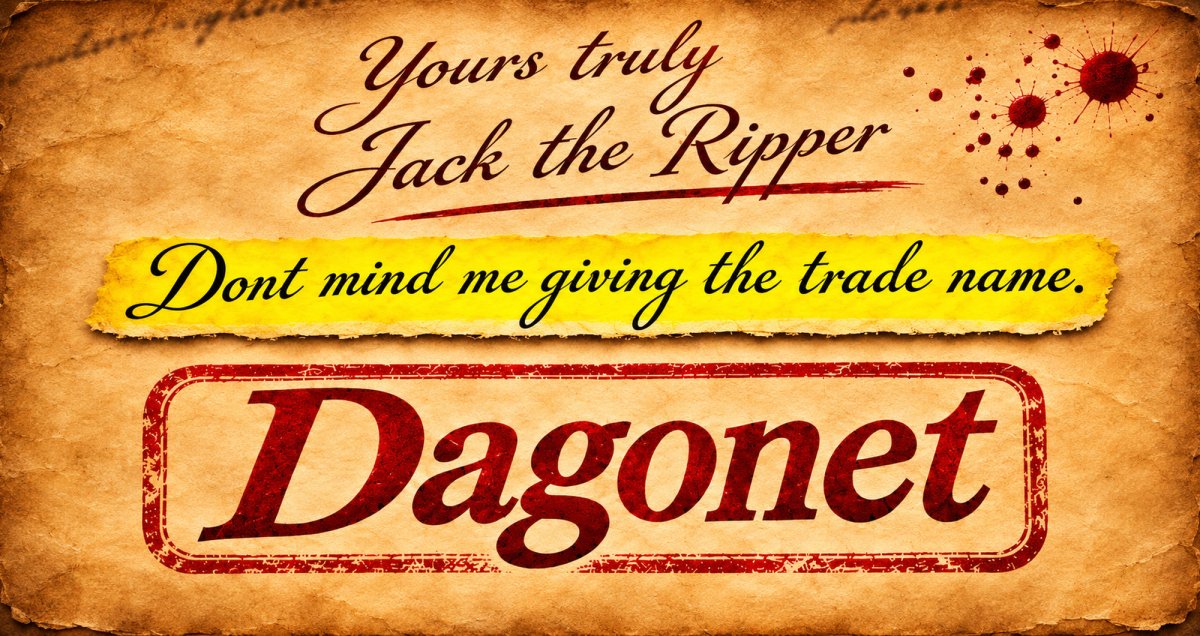
Nearly 140 years after the Whitechapel murders, a new hypothesis could shed light on the origins of the name Jack the Ripper. Within seven words of the famous Dear Boss letter, Jean Romain Cally has uncovered the pseudonym DAGONET.
What if the famous letter that gave Jack the Ripper his name contained the hidden signature of its true author?
Jean Romain Cally, a French statistician by profession, who holds a doctorate in management sciences and is a specialist in consumer psychology and an author, has discovered what could be a cryptogram concealing the pseudonym of a prominent Victorian journalist within the Dear Boss letter.
This discovery opens up a new avenue of investigation into a historical mystery dating back nearly 140 years.
Dated 25 September 1888, the Dear Boss letter is one of the most famous pieces of correspondence in criminal history. Several senior Scotland Yard officials subsequently suggested that it might have been a journalistic hoax. Yet the identity of its true author remains unknown.
Seven words that could conceal a signature
During his research, Jean Romain Cally focused on a particular detail in the Dear Boss letter: a short sentence of seven words placed immediately beneath the famous signature “Jack the Ripper”.
“Dont mind me giving the trade name”
At first glance, the sentence appears unremarkable. However, according to the French researcher, it could contain a deliberately concealed signature. By applying a decoding method based on letter correspondences, superimposition and a precise shift, he was able to reconstruct an exact seven-letter name: DAGONET.
Yet DAGONET is not a meaningless sequence of letters. It was the pen name under which George Robert Sims, a prominent British journalist and writer of the Victorian era, published many of his columns.
Even more intriguing is the fact that this pen name emerges from a sentence that specifically refers to the use of a professional name — a “trade name”.
This raises a fundamental question: is this correspondence the result of chance or evidence of deliberate intent?
George Robert Sims: a journalist at the heart of the mystery
Born in 1847, George Robert Sims was one of the leading figures of the London popular press. A journalist, novelist, playwright and columnist, he was particularly well known for his writings published under the pseudonym Dagonet in the weekly newspaper The Referee.
One particular detail caught Jean Romain Cally's attention. As early as September 1888, even before the Dear Boss letter was written, Sims had devoted several columns to the Whitechapel murders, their coverage in the newspapers and the way in which the press contributed to shaping the image of a single murderer.
As his investigation progressed, the French researcher also identified several similarities between expressions used in the letter and those found in Sims's writings.
Taken individually, these similarities might appear insignificant. However, considered alongside the possible cryptogram, they led Jean Romain Cally to examine this journalist more closely, exploring his literary world and his role within the Victorian press.
A hypothesis gradually emerged: could George Robert Sims, known under the pseudonym Dagonet, have been the author of the Dear Boss letter?
A new avenue of investigation into the history of Jack the Ripper
Jean Romain Cally's investigation does not seek to identify the Whitechapel murderer, but to answer a different question: who actually invented the name Jack the Ripper?
If the Dear Boss letter was indeed a journalistic hoax, its author would have contributed to the creation of one of the most famous myths in criminal history.
The discovery of the possible DAGONET cryptogram now invites a re-examination of the origins of this letter and the role George Robert Sims may have played in its creation.
Although this discovery alone cannot establish the identity of the letter's true author, it opens up a new avenue of research that deserves further examination.
A discovery freely accessible to everyone
Rather than seeking to promote his book commercially, Jean Romain Cally has chosen to make his entire investigation, The Man Who Invented Jack the Ripper, freely accessible online in French, English and Spanish.
The complete decoding of the possible cryptogram, the different stages of the method and the tests conducted are presented in his book, which is freely available to read online on Calaméo:
https://www.calameo.com/read/00834587432fd454b9a9d
He has also published several research papers on the scientific repository Zenodo, enabling anyone to examine the decoding method, the tests performed and the historical evidence accompanying this discovery.
https://zenodo.org/search?q=creators.name:%22Cally,+Jean+Romain%22
His primary objective is to bring this new avenue of investigation to the attention of the public and the scientific community, so that it can be examined, discussed and assessed alongside the work of historians, cryptographers and Jack the Ripper researchers.
Nearly 140 years after the Dear Boss letter was written, one question remains: could the seven words beneath the signature of Jack the Ripper contain the clue that generations of researchers have sought — the identity of the man who invented his name?